Delving into what is a person’s liquid net worth, this is the amount of money you have available at any given time to address unexpected expenses, pay off debt, or cover regular expenses during an emergency. Imagine you’re walking down a street in a foreign country and you suddenly need cash – would you have enough to cover it? In this article, we will break down the concept of liquid net worth, its significance in personal finance, and explore ways to maintain and optimize your own liquid net worth.
The significance of liquid net worth lies in its ability to provide financial stability during unexpected events, such as job loss or medical emergencies. It serves as a safety net that cushions financial shocks, allowing individuals to continue their daily lives without sacrificing their long-term financial goals. In essence, liquid net worth is the difference between what you own versus what you owe, with liquid assets like cash, checking accounts, and money market funds making up a large portion of that total.
By understanding how to calculate and manage liquid net worth, you can ensure that you have enough funds to cover unexpected expenses and continue working towards your financial objectives.
Defining Liquid Net Worth and Its Significance in Personal Finance: What Is A Person’s Liquid Net Worth

When it comes to personal finance, having a clear understanding of your liquid net worth is crucial for making informed decisions about your financial stability and future goals. Liquid net worth refers to the total value of your assets that can be easily converted into cash within a short period, typically 30 days or less. This includes accounts such as checking and savings accounts, stocks, bonds, mutual funds, and other liquid investments.In contrast, illiquid assets, like real estate or retirement accounts, may take longer to access or may come with penalties for early withdrawal.
Having a high liquid net worth not only provides a safety net in case of emergencies but also gives you the flexibility to pursue new opportunities or pay off high-interest debt.Understanding the importance of liquid net worth is the first step in achieving financial stability.
Calculating Liquid Net Worth: A Simple Example
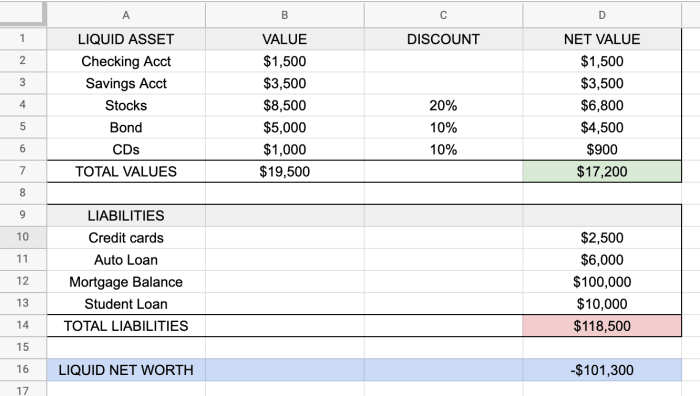
To calculate your liquid net worth, you need to add up the value of all your liquid assets, and subtract any debts or liabilities. Let’s consider an example of John, who has the following liquid assets:
Checking account
$10,000
Savings account
$20,000
Stocks
$30,000
Mutual funds
$40,000Total liquid assets: $100,000However, John also has the following liabilities:
Credit card debt
$5,000
Personal loan
$10,000To calculate John’s liquid net worth, you would subtract his liabilities from his total liquid assets:Liquid net worth: $100,000 – $15,000 = $85,000John’s liquid net worth provides a snapshot of his financial health and situation.
The Relationship Between Liquid Net Worth and Financial Stability
Having a high liquid net worth is directly linked to financial stability. It provides a cushion against unexpected expenses, such as car repairs or medical bills, and enables you to pay off high-interest debt or pursue new investment opportunities.A strong liquid net worth also allows you to weather financial storms, such as job loss or market downturns.The connection between liquid net worth and financial stability is clear: having a solid safety net can help you make informed decisions about your financial future.
Factors That Affect Liquid Net Worth Over Time, What is a person’s liquid net worth
Several factors can impact your liquid net worth over time, such as changes in the stock market, shifts in interest rates, or unexpected expenses. To maintain a healthy liquid net worth, it’s essential to regularly review and adjust your financial strategy.Some common factors that affect liquid net worth include:
- Cash flow: Your income and expenses can significantly impact your liquid net worth. A steady income and well-managed expenses can help you build your safety net.
- Investment performance: The performance of your securities, such as stocks or mutual funds, can affect your liquid net worth.
- Debt obligations: Your debt liabilities, including credit card debt or personal loans, can reduce your liquid net worth.
- Savings habits: Failing to save regularly can erode your liquid net worth over time.
- Inflation: A rapidly rising inflation can eat away at the purchasing power of your liquid assets.
Regularly reviewing and adjusting your financial plan is key to maintaining a healthy and growing liquid net worth.
Organizing Assets and Liabilities: A List to Illustrate the Concept
To better understand your liquid net worth, it’s helpful to categorize your assets and liabilities. Here’s a list of common liquid assets and liabilities:| Assets | Value || — | — || Checking account | $10,000 || Savings account | $20,000 || Stocks | $30,000 || Mutual funds | $40,000 || Bonds | $15,000 || Liabilities | Value || — | — || Credit card debt | $5,000 || Personal loan | $10,000 || Car loan | $15,000 |To determine your liquid net worth, simply add the value of your liquid assets and subtract your liabilities.
Liquid net worth is the sum of your liquid assets minus your debts or liabilities.
Calculating and regularly monitoring your liquid net worth can help you make informed decisions about your financial future and achieve long-term financial stability.
Components of Liquid Net Worth

When it comes to calculating liquid net worth, one of the most important components is understanding what types of assets can be easily converted into cash. This includes cash savings, checking accounts, and money market funds, which are considered ultra-short-term investments with very low risk.In this section, we’ll explore the different types of liquid assets that can contribute to an individual’s liquid net worth, as well as some of the risks associated with investing in these assets.
Comparison of Cash Savings, Checking Accounts, and Money Market Funds
While all three of these options can be used to store liquid assets, there are some key differences to consider. Cash savings accounts are typically offered by banks and offer FDIC insurance, which protects deposits up to $250,000. Checking accounts are also offered by banks and allow for easy access to funds, but they often come with fees and restrictions on overdrafts.
Money market funds, on the other hand, are a type of investment that pools money from multiple investors to purchase low-risk, short-term debt securities.
- Cash Savings Accounts: These accounts are great for emergency funds and offer FDIC insurance.
- Checking Accounts: These accounts are best for everyday spending and may come with fees or restrictions.
- Money Market Funds: These investments offer a low-risk way to earn interest on liquid assets, but may come with some level of risk if the funds invest in securities that default.
Examples of Liquid Assets: Stocks, Bonds, and Mutual Funds
In addition to cash and money market funds, other types of liquid assets can include stocks, bonds, and mutual funds. Stocks represent ownership in a company and can be highly volatile, while bonds represent a loan to a borrower and typically offer a fixed rate of return. Mutual funds are a type of investment that pools money from multiple investors to purchase a variety of assets, including stocks, bonds, and other securities.
- Stocks: These represent ownership in a company and can be highly volatile.
- Bonds: These represent a loan to a borrower and typically offer a fixed rate of return.
- Mutual Funds: These are a type of investment that pools money from multiple investors to purchase a variety of assets.
Risks Associated with Liquid Assets
While liquid assets offer a low-risk way to store and invest money, there are some risks to consider. For example, if you invest in a stock or bond that defaults, you may lose some or all of your investment. Additionally, if you invest in a mutual fund that is heavily invested in a particular sector or industry, you may be exposed to sector-specific risks.
| Risk | Description |
|---|---|
| Default Risk | The risk that a borrower will fail to make payments on a loan or bond. |
| Sector-Specific Risk | The risk that a particular industry or sector will experience a downturn, resulting in losses for investors. |
| Liquidity Risk | The risk that it may be difficult or impossible to sell an asset quickly enough to meet a need for cash. |
In general, it’s a good idea to diversify your liquid assets across a variety of different types, including cash savings accounts, checking accounts, money market funds, stocks, bonds, and mutual funds.
Calculating and Managing Debt in Liquid Net Worth

Understanding liquid and non-liquid debt is crucial in calculating net worth. Liquid debt, also known as short-term debt, is immediate in nature and easily accessible, such as credit card balances or personal loans. On the other hand, non-liquid debt, or long-term debt, includes mortgages, car loans, and student loans, which take longer to repay. In managing debt, it’s essential to prioritize liquid debt over non-liquid debt due to its immediate financial impact.
Difference Between Liquid and Non-Liquid Debt
Liquid debt can quickly drain your liquid net worth, whereas non-liquid debt, although taking longer to repay, typically has lower interest rates and a fixed repayment schedule. By prioritizing liquid debt, you can minimize its impact on your net worth. For instance, consider paying off a high-interest credit card balance before investing in a long-term retirement plan.
Strategies for Managing Debt
To manage debt effectively, consider the following strategies:
-
Debt Snowball Method:
This method involves paying off debts with the smallest balances first, while making minimum payments on larger debts.
-
Debt Avalanche Method:
This method prioritizes debts with the highest interest rates, ensuring the most significant savings on interest payments.
-
Consolidation Loans:
Combining multiple debts into a single loan with a lower interest rate and a longer repayment period can simplify debt management and save on interest payments.
-
Debt Repayment Plans:
Create a personalized plan that suits your financial situation, considering income, expenses, and debt obligations.
Debt Repayment Plans and Their Effectiveness
A well-structured debt repayment plan can help you manage debt efficiently. Consider the 50/30/20 rule, where 50% of your income goes towards essential expenses, 30% towards discretionary spending, and 20% towards savings and debt repayment.| Repayment Plan | Description | Effectiveness || — | — | — || Debt Snowball | Pay off smallest balance first | Moderate || Debt Avalanche | Pay off highest interest rate first | High || Consolidation Loans | Combine debts into a single loan | Moderate to High || Debt Repayment Plans | Personalized plan based on income, expenses, and debt | High |
Debt Management Tools and Resources
To manage debt effectively, consider the following tools and resources:
-
Budgeting Apps:
Utilize apps like Mint, You Need a Budget (YNAB), or Personal Capital to track expenses and income, creating a personalized budget.
-
Debt Counseling Services:
Non-profit organizations like the National Foundation for Credit Counseling (NFCC) or the Financial Counseling Association of America (FCAA) offer free or low-cost debt counseling.
-
Debt Management Plans (DMPs):
Develop a customized plan with a credit counselor to consolidate debts and negotiate interest rates.
Maintaining and Optimizing Liquid Net Worth Over Time
Maintaining a healthy liquid net worth is a crucial aspect of personal finance. It serves as a financial safety net, enabling individuals to cover unexpected expenses, make the most of investment opportunities, and achieve long-term financial goals. In this section, we will discuss strategies for maintaining and optimizing liquid net worth over time, with a focus on regular financial reviews, adjustments, and the creation of an emergency fund.
Regular Financial Reviews and Adjustments
Regular financial reviews are essential for maintaining liquid net worth over time. They help individuals track their financial progress, identify areas for improvement, and make informed decisions about investments and spending. Ideally, these reviews should be conducted quarterly or bi-annually, with adjustments made as needed to ensure that the liquid net worth remains stable and aligned with financial goals.
- Track income and expenses: Monitor income and expenses to identify areas where spending can be reduced and savings maximized.
- Evaluate investment performance: Regularly review investment portfolios to ensure that they are aligned with financial goals and risk tolerance.
- Adjust investment allocations: Rebalance investment portfolios to maintain an optimal asset allocation and minimize risk.
- Assess debt obligations: Review debt obligations to ensure that they are manageable and aligned with financial goals.
Creating an Emergency Fund
An emergency fund is a critical component of maintaining liquid net worth. It provides a financial safety net, enabling individuals to cover unexpected expenses without dipping into long-term savings or investments. The ideal emergency fund should cover 3-6 months of living expenses, providing a cushion against financial shocks and uncertainties.
- Determine monthly expenses: Calculate monthly expenses, including essential costs such as housing, utilities, and food.
- Set an emergency fund goal: Based on the calculation of monthly expenses, set an emergency fund goal that covers 3-6 months of living expenses.
- Select a funding strategy: Choose a funding strategy, such as setting aside a fixed amount each month or allocating a portion of income to the emergency fund.
- Evaluate and adjust: Regularly review the emergency fund to ensure that it remains aligned with financial goals and adjust the funding strategy as needed.
Other Strategies for Maintaining Liquid Net Worth
In addition to regular financial reviews and emergency fund creation, there are several other strategies that individuals can use to maintain liquid net worth over time. These include:
- Diversifying investments: Spread investments across a range of asset classes, such as stocks, bonds, and real estate, to minimize risk and maximize returns.
- Maximizing tax-advantaged accounts: Utilize tax-advantaged accounts, such as 401(k)s and IRAs, to save for retirement and other long-term goals.
- Building multiple income streams: Develop multiple income streams, such as through investments or a side business, to reduce reliance on a single source of income.
- Maintaining a low debt-to-income ratio: Keep debt obligations low by avoiding excessive credit card usage and paying off high-interest debt promptly.
Aiming to maintain a healthy liquid net worth requires discipline, patience, and a long-term view. By regularly reviewing finances, creating an emergency fund, and employing other strategies, individuals can build a strong financial foundation and achieve long-term financial stability.
Last Point
Understanding what is a person’s liquid net worth is crucial for building a strong financial foundation. By calculating and managing your liquid net worth, you’ll be better equipped to handle life’s unexpected twists and turns. Whether you’re looking to boost your emergency fund, pay off debt, or reach long-term financial goals, knowing the ins and outs of liquid net worth will provide you with the clarity and confidence you need to make informed financial decisions.
Q&A
What is the ideal liquid net worth ratio?
The ideal liquid net worth ratio varies depending on individual circumstances, but generally, experts recommend having 3-6 months’ worth of expenses in liquid assets.
Can I use retirement savings as liquid assets?
While retirement savings can be liquidated in case of an emergency, tapping into these funds may incur penalties and taxes, making them less preferred sources of emergency funding.
How often should I review my liquid net worth?
Regularly review your liquid net worth every 6-12 months to ensure you’re on track with your financial goals and make adjustments as needed.
Can I use a home equity line of credit as a liquid asset?
No, a home equity line of credit (HELOC) is a non-liquid asset that requires ongoing payments and may not be easily accessible in case of an emergency.
